
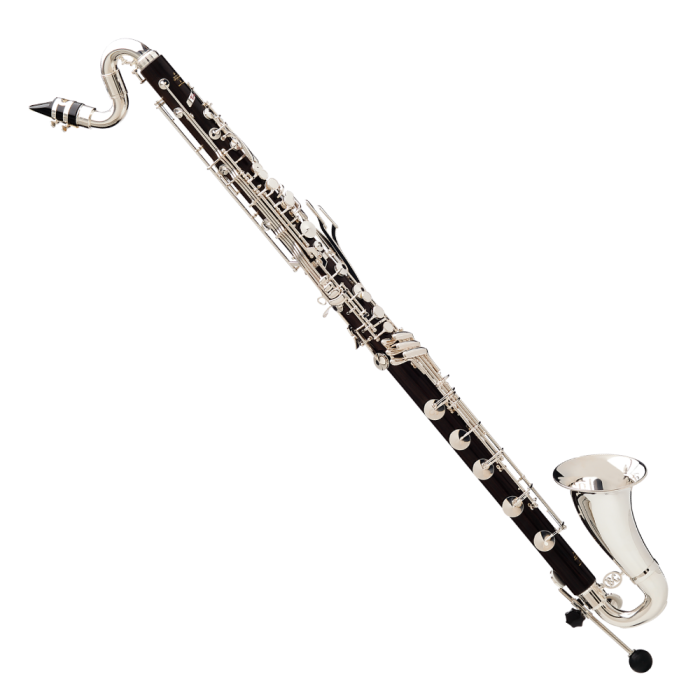
Assembly of this Bass Clarinet
Firstly, apply cork grease Buffet Crampon thinly to the joint corks to make the assembly easier.
NB : cork grease needs to be applied every time when the assembly is difficult. Never use force to avoird insturment from cracking.
- Assemble the top joint with the bottom joint.
Hold the top joint with the left hand and the bottom joint with the right hand and insert, taking care not to apply any excessive force to the keys. Make sure that on each joint are line with each oher. - Assemble the bottom joint and the bell.
Hold the joint part of the bell with the left hand and the bottom joint with the right hand and assemble.
The instrument descending to low Eb also has a key on the bell. Keep holding the cap of the key on the bell so that the key on the bottom joint will not hit the key on the bell. - Fix the pin to the bell firmly with the screw.
- Assemble the bocal and the top joint. Hold the joint part of the bocal with the right hand and the top joint with the left hand near the bocal.
- Fix the reed to the mouthpiece.
Mount the ligature on the mouthpiece and slip in the dampened reed. Then tighten the screw of the ligature. Put the reed straight with the mouthpiece.
Note : take care not to damage the mouthpiece top or the reed with the ligature. After playing, cap the mouthpiece to protect it and the reed from damage. - Assemble the mouthpiece with the bocal. Hold the bocal with the left hand near the joint of the mouthpiece supporting from the bottom and the mouthpiece with the right hand, and assemble.
Disassembly of the instrument
Diassemble in reverse order
Daily care
- To prevent corrosion, wipe the keywork with a dry polishing cloth after each performance.
- Always use the Buffet Crampon case provided for the instrument. Too tight or too loose a case may cause bending of keys.
- Under non circumstances use oil, solvents or anti-corrosive products.
Pitch
The pitch of a wind instrument is greatly affected by temperature.
The Buffet Crampon clarinet is designed to reach its pitch when it is played a four minutes in a room of average temperature (20°c).
Pitch adjustment
- When the barrel – top joint is pulled out: the pitch of the instrument generally lowers, but especially the notes in the upper part of the top joint.
- When the top joint – bottom joint are pulled out: the pitch of the instrument generally lowers, but especially the notes in the upper part of the bottom joint.
To prevent cracks on the body
- In the case of a new instrument, do not play it continuously for more than 30 minutes daily during the first month.
- Avoid any rapid change of temperature and humidity. For instance, do not leave the instrument in the blazing sun, out-door in winter, or near an air-conditioner, or heater.
- Apply cork grease on the joint cork
- Before putting the instrument in th case, dry the bore completely with your pull-through (swab).
- No bore oil, etc. needs to be used to prevent cracks in a new instrument. Observing the precautions in 1. to 3. is sufficient.
Note: Should any wooden instrument crack, it will never affect the intonation and tone quality if the instrument is properly repaired.
Use of a swab
- Whilst playing the instrument, use a swab frequently (every 10-15 minutes). If water collects in the tone hole, bubbling and swelling of pads with consequent leakage will badly affect the performance. I f so, dry pads with cigarette paper.
Note: Pass a swab through the barrel towards the bell. It may otherwise be caught by a tube protruding inwardly in the upper part of the top joint. - When the swab is soiled, replace it with a new one. If a soiled or a fluffy one resulting from over washing is used, dust may collect in the tone holes.
- Do not put a wet swab in the case with the instrument. The wet swab may cause rust on the springs and the discoloration of the keywork.
If the event of any problems, please contact your dealer.